


Melampodium: Melampus, the Daughters of Proetus, and the First Recorded Psychiatric Treatment in the West
A myth, a plant, and the chemistry that turned out to be real.
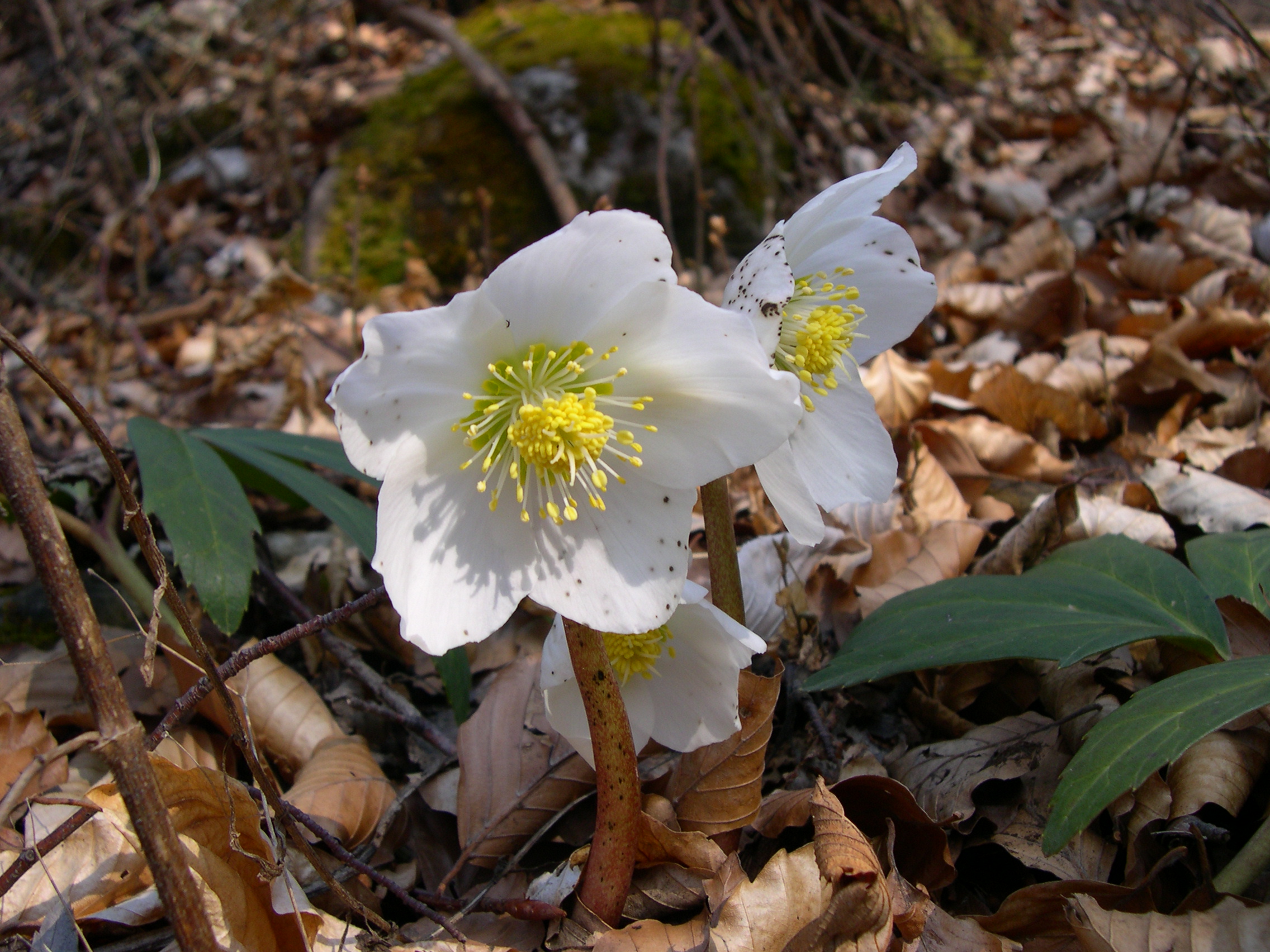
Helleborus niger, the black hellebore of Dioscorides and the Melampus myth. Photo: Archenzo, Wikimedia Commons, CC BY-SA 3.0/GFDL.
There is a plant that carries a man's name. Not a genus named for the botanist who classified it — a species named, in antiquity, for the person who was said to have first used it as medicine. The Greeks called black hellebore Μελαμπόδιον, Melampodion — "Melampus's plant." And the story behind that name is, depending on how you read it, either the West's founding myth of psychiatry or a very old case study in a healer holding a kingdom hostage. It's probably both.
The princesses who went mad
King Proetus ruled Tiryns, the cyclopean-walled citadel in the Argolid that predates and rivals Mycenae itself. His three daughters — Lysippe, Iphinoë, and Iphianassa, sometimes called the Proetides — were, in most versions of the story, struck with madness for an act of religious disrespect: some sources say they refused the rites of Dionysus, others that they insulted Hera.[^hesiod][^apollod] Whatever the offense, the result was the same. The women fled into the wilderness, ran through the mountains of the Argolid and into Arcadia, and the affliction spread — other women of Argos joined them, some reportedly killing their own children in their frenzy.[^apollod] This is the detail that separates the Proetides myth from an ordinary madness story: it describes a contagious psychological breakdown that consumed an entire community, not just three sisters.
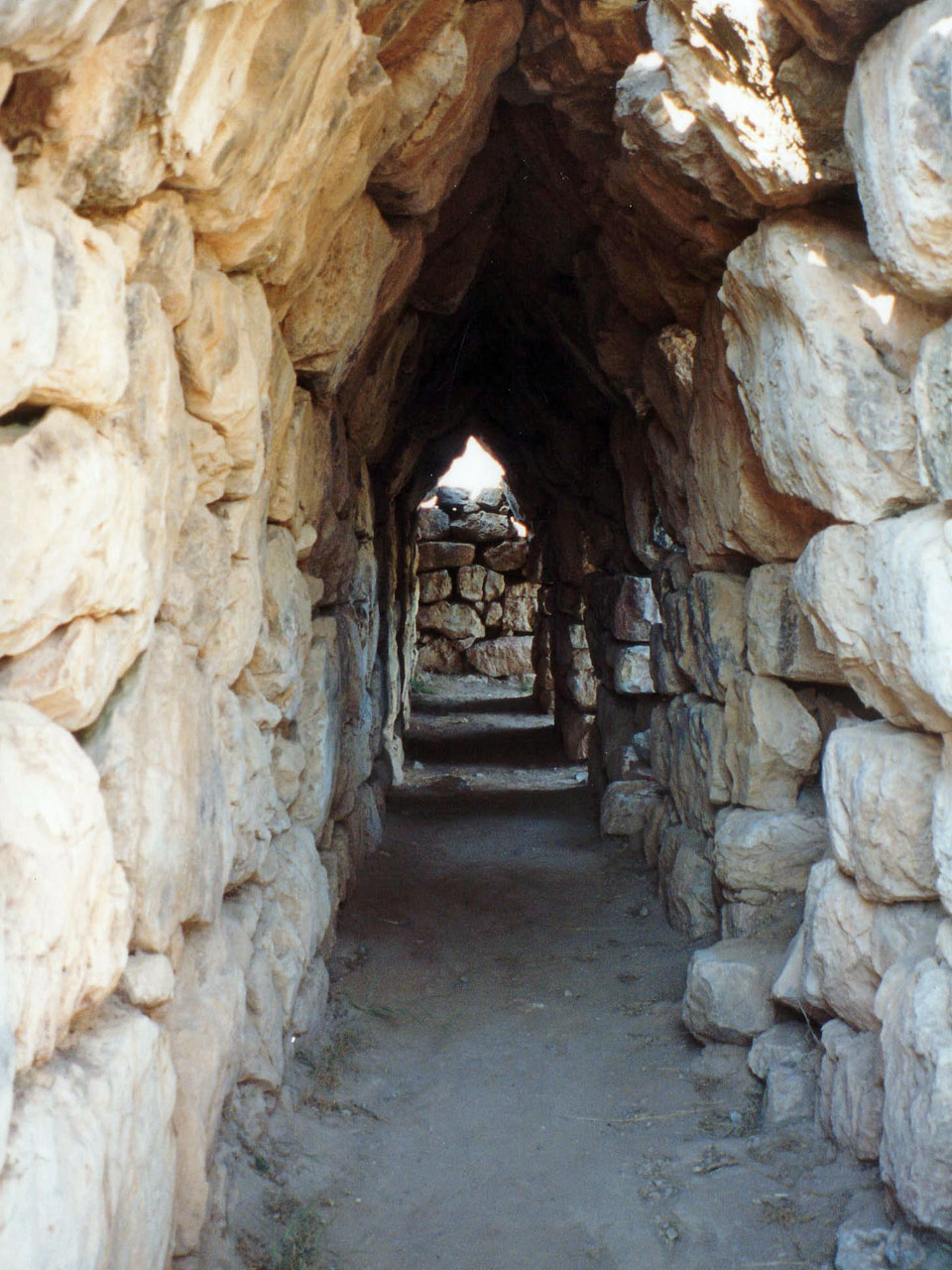
Interior gallery within the Cyclopean walls of Tiryns, the citadel of King Proetus. Photo: Flickr upload, Wikimedia Commons, CC BY-SA 2.0.
The seer who wasn't a doctor
Enter Melampus — not a physician, but a mantis, a seer. Apollodorus's Bibliotheca credits him as the discoverer of "the treatment of disease through drugs and purifications" combined.[^apollod] His prophetic gift, by legend, came from raising the orphaned young of two snakes he'd found; grateful, the serpents licked his ears clean while he slept, and he awoke able to understand the speech of birds and animals.[^melampus-wiki] He was, in the vocabulary of the period, a pharmakeus — someone who works with pharmaka, substances that were simultaneously medicine, poison, and ritual agent, with no firm boundary drawn between the three.
Proetus offered a reward for curing his daughters. Melampus asked for a third of the kingdom. Proetus refused — and the madness worsened, spreading further among the women of Argos.[^apollod] Proetus came back, more desperate. This time Melampus doubled his price: a third of the kingdom for himself, and another third for his brother Bias.[^proetids-wiki] Proetus agreed. Only then did Melampus act — leading strong young men in a ritual pursuit, driving the afflicted women through the mountains toward Sicyon with shouting and frenzied dancing. The eldest, Iphinoë, died during the chase. The other two recovered, were purified, and were married off to Melampus and Bias as part of the settlement — along with their thirds of the kingdom.[^apollod][^proetids-wiki]
Strip away the myth and what's left is stark: a healer extracted two-thirds of a kingdom by letting a public health crisis get worse before he'd treat it. The cure itself was violent — an induced, forced, physically punishing purge. And it is credited with working.
What Dioscorides actually recorded
Centuries later, the physician Pedanius Dioscorides compiled De Materia Medica (1st century AD), the foundational pharmacological reference of the ancient Mediterranean world. In his entry on black hellebore, he explains the plant's alternate name directly: it is called Melampodion, he writes, because it was thought (dokei — he hedges, as he often does with legendary material) that Melampus, a goatherd, used it to purge and cure the daughters of Proetus.[^diosc] Dioscorides records that black hellebore purges the lower intestine, expelling phlegm and bile, and lists it as a treatment for epilepsy, "melancholia" (severe depression), delirium, and mania.[^diosc]
.jpeg)
Author portrait of Dioscorides, from the early 6th-century Vienna Dioscurides manuscript — the oldest surviving illustrated copy of De Materia Medica. Wikimedia Commons, public domain.
This links directly to Greek humoural medicine. Melancholia — literally "black bile" — was thought to result from an excess of melaina cholē, black bile, one of the four humours. Black hellebore was specifically associated with purging that humour, which is why it became the standard prescription for madness and depression alike. The town of Anticyra, which Dioscorides names as producing the finest black hellebore, became proverbial: telling someone "you need to go to Anticyra" was slang for "you're insane" — the ancient equivalent of "you need a dose of hellebore." The phrase appears as a taunt in Aristophanes and other comic writers.[^ls-lexicon]
The modern pharmacology — and this is where the myth gets interesting
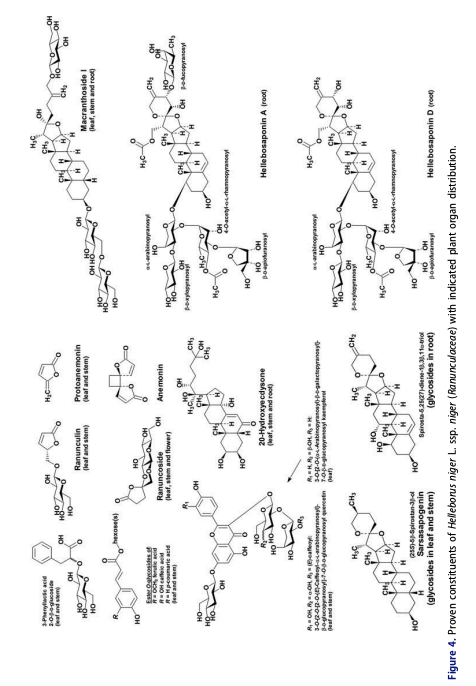
For most of the 20th century, this was filed under folklore: an ancient purgative superstitiously linked to mental illness through a theory (humoural medicine) that modern medicine discarded outright. Recent phytochemical and pharmacological work has complicated that dismissal considerably.
What's actually in the plant. Helleborus niger contains a distinctive set of bioactive compounds: bufadienolides (cardiac glycosides structurally related to toad-venom toxins) including hellebrin and its aglycone hellebrigenin; furostanol saponins; ecdysteroids; flavonoids; and protoanemonin.[^bioactive-review][^brillatz]
Hellebrin and hellebrigenin. These are the plant's primary cardiotonic glycosides — historically studied for cardiac applications, and more recently as candidate anticancer lead compounds.[^bioactive-review] A 2020 study using a zebrafish seizure model found that hellebrin, and even more potently its aglycone hellebrigenin, reduced pentylenetetrazole-induced seizure activity — direct pharmacological evidence for the plant's long ethnobotanical use against epilepsy in ancient Greek medicine.[^brillatz] A follow-up phytochemical study of a related species, H. odorus subsp. cyclophyllus, notes that the compound's mechanism of action, while not fully resolved, is understood to involve allosteric modulation of the GABA-A receptor[^tsiftsoglou] — the same receptor class targeted by modern benzodiazepines and other anxiolytic/sedative drugs.
Sarsasapogenin. Separately, H. niger leaf and stem tissue contains sarsasapogenin as a glycosylated saponin. In controlled animal studies, sarsasapogenin produced antidepressant-like effects — increasing resistance to stress-induced behavior in the Vogel conflict test and raising brain concentrations of serotonin, noradrenaline, and dopamine in the hypothalamus and hippocampus — performing comparably to the SSRI fluoxetine used as the reference compound.[^ren]
None of this makes black hellebore a safe or recommended treatment by modern standards — it remains a genuinely toxic plant, and its cardiotoxicity is well documented.[^tsiftsoglou] But the pattern is hard to dismiss as coincidence: a plant tied by name and myth to the first recorded "cure" of mental illness in the Western tradition turns out, on modern pharmacological analysis, to contain compounds that are anticonvulsant, GABA-A active, and antidepressant. The ancient diagnostic framework (excess black bile) was wrong. The empirical result — this plant measurably changes brain chemistry in ways relevant to mood and seizure disorders — was not.
Why classicists and psychiatrists both keep returning to this story
This isn't just a matter of amateur interest in old myths meeting new chemistry — it's an active thread in the academic literature on the history of psychiatry. A 2017 paper in the Journal of the History of the Neurosciences, "Pharmacology and psychiatry at the origins of Greek medicine: The myth of Melampus and the madness of the Proetides," undertakes exactly this analysis: tracing the ancient sources, attempting a retrospective diagnostic read of the Proetides' described symptoms, and reviewing the pharmacological literature on Helleborus niger's neurological activity.[^olivieri] The authors argue that the legend reflects a genuinely "medicalizing" moment in the early history of Greek medical thought — an early, intuitive articulation of psychiatric treatment, wrapped in myth but grounded in real observation and real (if crude and dangerous) pharmacology.
An earlier historical note in History of Psychiatry makes a similar case even more directly, describing Melampus as, in effect, "a psychiatrist before psychiatry."[^ntafoulis]
The uncomfortable part
It's worth resisting the temptation to romanticize this into a simple "the ancients knew more than we thought" story. What the sources describe is brutal: a healer who let a psychiatric crisis metastasize across an entire community while he negotiated for two-thirds of a kingdom, then treated it with a violent, physically dangerous purge — administered via a forced chase through the mountains — that killed the eldest of the three women he was nominally trying to save.[^apollod] The "cure" worked, by the ancient sources' own account, for the other two. But it worked despite methods that would constitute serious harm by any modern clinical standard.
That tension — real pharmacology, real coercion, real casualties — is arguably the more historically honest takeaway than either "ancient wisdom" or "primitive superstition" alone.
Primary sources
- Apollodorus, Bibliotheca ("The Library") 1.9.12, 2.2.2. Trans. J. G. Frazer, Loeb Classical Library, 1921. Perseus Digital Library
- Hesiod, Catalogue of Women (Ehoiai), frr. 129–133 (Merkelbach–West)
- Herodotus, Histories 9.33–34. Trans. A. D. Godley, 1920. Perseus Digital Library
- Bacchylides, Epinician Odes 11.85–110. Perseus Digital Library
- Pausanias, Description of Greece 2.18.4, 5.5.10, 8.18.8. Trans. W. H. S. Jones & H. A. Ormerod, 1918. Perseus Digital Library
- Diodorus Siculus, Bibliotheca Historica 4.68.4. Trans. C. H. Oldfather, Loeb Classical Library 340, 1939.
- Dioscorides, De Materia Medica 4.162 (entry on Elleboros melas / black hellebore, i.e. Melampodion)
- Strabo, Geography 8.3.19. Perseus Digital Library
- Liddell & Scott, A Greek-English Lexicon, s.v. ἑλλέβορος
Scientific literature
- https://sci-hub.ru/https://www.tandfonline.com/doi/full/10.1080/0964704X.2016.1211901
- Olivieri, M. F., Marzari, F., Kesel, A. J., Bonalume, L., & Saettini, F. (2017). Pharmacology and psychiatry at the origins of Greek medicine: The myth of Melampus and the madness of the Proetides. Journal of the History of the Neurosciences, 26(2), 193–215. https://doi.org/10.1080/0964704X.2016.1211901
- Ntafoulis, P., Gourzis, P., & Trompoukis, C. (2008). Melampous: a psychiatrist before psychiatry. History of Psychiatry, 19(2), 242–246. https://doi.org/10.1177/0957154X07078704
- Brillatz, T., et al. (2020). Antiseizure potential of the ancient Greek medicinal plant Helleborus odorus subsp. cyclophyllus and identification of its main active principles. Journal of Ethnopharmacology, 259, 112954. https://doi.org/10.1016/j.jep.2020.112954
- Tsiftsoglou, O. S., et al. (2018). Chemical constituents isolated from the rhizomes of Helleborus odorus subsp. cyclophyllus (Ranunculaceae). South African Journal of Botany.
- Ren, Y., et al. (2006/2007). Antidepressant-like effects of sarsasapogenin from Anemarrhena asphodeloides Bunge (Liliaceae). Pharmazie, 62(1), 78–79.
- Cuny, E. (2023). Bioactive Ingredients of Helleborus niger L. (Christmas Rose): The Renaissance of an Old Medicinal Herb — A Review. Natural Product Communications.
Educational information only — not medical advice. Black hellebore is toxic and should never be self-administered.
[^hesiod]: Hesiod, Catalogue of Women, frr. 129–133 M.-W.[^apollod]: Apollodorus, Bibliotheca 2.2.2.[^melampus-wiki]: Melampus, Wikipedia, summarizing Apollodorus and related sources on the origin of his prophetic gift.[^proetids-wiki]: Proetids, Wikipedia, summarizing Apollodorus, Bacchylides, and other ancient sources.[^diosc]: Dioscorides, De Materia Medica 4.162.[^ls-lexicon]: Liddell & Scott, A Greek-English Lexicon, s.v. ἑλλέβορος.[^bioactive-review]: Cuny, E. (2023). Bioactive Ingredients of Helleborus niger L. — A Review. Natural Product Communications.[^brillatz]: Brillatz, T., et al. (2020). Journal of Ethnopharmacology, 259, 112954.[^tsiftsoglou]: Tsiftsoglou, O. S., et al. (2018). South African Journal of Botany.[^ren]: Ren, Y., et al. (2006/2007). Pharmazie, 62(1), 78–79.[^olivieri]: Olivieri, M. F., et al. (2017). Journal of the History of the Neurosciences, 26(2), 193–215.[^ntafoulis]: Ntafoulis, P., Gourzis, P., & Trompoukis, C. (2008). History of Psychiatry, 19(2), 242–246.





.jpg)